
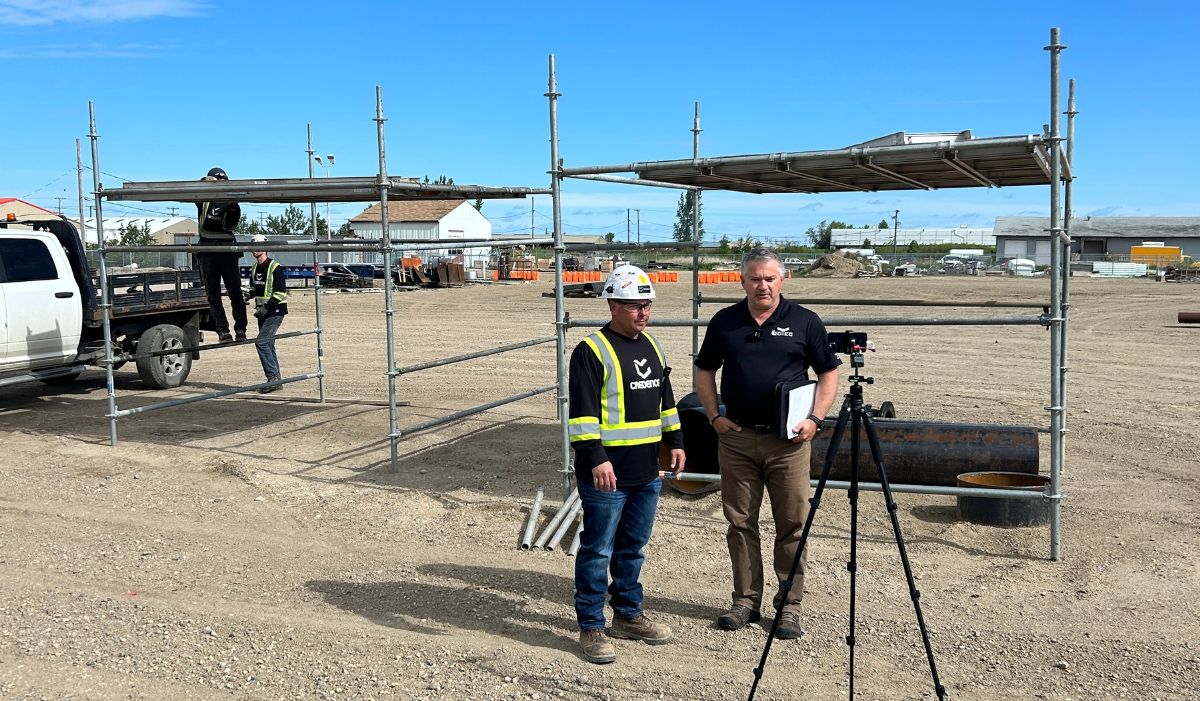
COR Certification in Construction: What It Means and Why Prairie Industrial Clients Should Never Skip This Question
Before a single RFQ gets issued on most major industrial projects in Saskatchewan and Alberta, there is usually one question that quietly filters the contractor list in half.
“Are you COR certified?”
It does not matter how competitive your pricing is, how many years you have been operating, or how strong your references are. If the answer is no, a growing number of industrial clients in agriculture and mining will not take the conversation further. That is not them being difficult. That is them doing their job properly.
We understand why — because we have been on both sides of that question for years. At Credence Construction Ltd., COR certification is part of how we show up to work every single day across Saskatchewan, Alberta, Manitoba, and Western Ontario. This article is not a pitch for our services. It is an honest explanation of what COR certification actually means in the real world of industrial construction, and why the clients who require it are making the right call.
What is COR Certification? (And Why a “Safety Binder” Isn’t Enough)
COR stands for Certificate of Recognition. It is a Canadian safety accreditation program, nationally trademarked and endorsed by the Canadian Federation of Construction Safety Associations (CFCSA), that independently verifies whether a contractor has built and is actively running a legitimate health and safety management system.
In Saskatchewan, the program is managed by the Saskatchewan Construction Safety Association — the SCSA. In Alberta, it runs primarily through the Alberta Construction Safety Association, the ACSA, under the provincial government’s Partnerships in Injury Reduction program.
Here is the part most people misunderstand. COR is not a course you take and a certificate you hang on the wall. It is an ongoing, audited commitment. To earn it, a third-party auditor comes to your operation — not to your office, but to your actual job sites — reviews your documentation, watches how your crews work, and interviews your workers directly. If the safety system that lives in your binder is not the same one your workers are following in the field, you do not get certified. It is that simple.
That gap between “we have a safety manual” and “our people actually follow it every day” is exactly what COR is designed to measure. And for clients trusting a contractor with their facility and their people, that gap is everything.
Why the Biggest Industrial Buyers in the Prairies Have Made It Non-Negotiable
Potash producers, fertilizer operations, grain processing companies, mining firms — the organizations that drive the industrial economy across Saskatchewan and Alberta — did not arrive at COR requirements by accident. They got there the hard way, through experience with what happens when contractor safety systems are assumed rather than verified.
When something goes wrong on your site involving a contractor’s crew, the liability question does not stay with the contractor. It comes back to you. Regulators want to know what prequalification process you used. Legal counsel wants to know what safety verification steps were taken before that crew was granted site access. Insurers want to know whether the contractor met a recognized national standard.
A COR-certified contractor gives you a documented, independently audited answer to every one of those questions. It is not a guarantee that nothing will ever go wrong — no certification in any industry can promise that. What it does guarantee is that you exercised proper due diligence, that your contractor’s safety system was verified by someone other than the contractor themselves, and that there is a paper trail that reflects a professional standard of care.
Beyond the liability question, there is a practical operational reason large industrial clients require it. Evaluating the safety programs of eight or ten competing contractors before awarding a contract is genuinely time-consuming work for a procurement or safety team. COR certification removes that burden. If a contractor holds a current, valid certificate through the SCSA or ACSA, you already know they cleared a rigorous, standardized bar. You can move on to evaluating the rest of what matters.
What a COR-Certified Contractor Actually Looks Like on Your Site
The certification is earned in an auditor’s evaluation. But the real proof of it shows up in how a crew behaves on your site from day one — and that is worth understanding before you hire anyone.
On a Credence job site, the safety system is not something that gets activated when a client’s safety officer walks through the gate. Hazard assessments happen before work starts each morning. Equipment inspections are documented, not assumed. Safe work procedures for confined space entry, working at heights, hot work near operating equipment, and heavy lifts are written down, understood by the crew doing the work, and signed off before those tasks begin. When something unexpected changes mid-shift — a weather event, a equipment issue, a change in scope — the process for reassessing and communicating that change is already in place.
This matters especially in the kind of multi-trade industrial work Credence does. When our construction solutions team has millwrights, ironworkers, welders, scaffolders, and carpenters all working in the same footprint — which happens regularly on plant shutdowns and greenfield agricultural builds — the safety interactions between those trades have to be actively managed. A scaffolder erecting a crash deck three metres above where a welder is working is a coordination issue before it is a safety issue. COR certification means there is a system for identifying and managing exactly that kind of interaction before anyone gets hurt.
It is also why safety planning is built into the drafting and design phase at Credence, not bolted on after the fact. A project that is sequenced properly on paper — with trade access, crane picks, and confined space permits all mapped out before mobilization — is a fundamentally safer project than one where those decisions get made reactively in the field.
How COR-Certified Contractors Save You Money
There is a money angle to COR certification that does not get talked about enough from the client’s perspective, and it is worth understanding.
In Alberta, contractors who maintain COR status through the ACSA qualify for WCB premium rebates of up to 20 percent through the Partnerships in Injury Reduction program. In Saskatchewan, COR-certified companies accumulate better WCB experience ratings over time as their injury rates drop — which directly affects what they pay in premiums year over year.
What this means for you as a client is straightforward: a COR-certified contractor has a direct financial stake in running a clean, injury-free site. Not just a moral obligation. Not just a regulatory requirement. An actual financial incentive that is tied to the WCB system and renewed every year.
Compare that to a contractor who carries no certification, has no external auditing of their safety practices, and whose only motivation to prevent injuries is avoiding the disruption of an incident. The incentive structures are not the same — and on a tight turnaround at a processing facility or a compressed greenfield schedule, those incentive structures matter.
The Question Worth Asking Before You Sign the Contract
If you are in the middle of evaluating contractors right now for an industrial project in Saskatchewan or Alberta, there is a specific way to use COR certification as a screening tool that goes beyond just asking “do you have it.”
Ask for the certificate number and the name of the certifying body — SCSA or ACSA — and verify it directly. Both organizations maintain searchable lists of certified companies. If a contractor cannot provide a current certificate number, or if the certificate turns out to be expired, that tells you something important about how seriously they treat their safety obligations.
Ask who their internal safety auditor is and whether that person is a full-time employee. Ask what their last external audit score was. Ask how they handle the safety onboarding process when a crew is new to your specific site. A contractor with a genuine COR culture will answer all of these questions without hesitation and without having to dig through files to find the answers. Those things will be known, current, and front of mind.
A contractor who fumbles those questions has a certificate. That is different from having a safety culture.
Why This Matters Specifically When Hiring Credence
We are not writing this article to lecture the industry about safety. We are writing it because the clients we work best with — operations managers at Saskatchewan mining facilities, maintenance leads at Alberta agricultural plants, project engineers managing capital upgrades across the Prairies — already understand the value of COR certification. They just want confirmation that the contractor sitting across the table from them takes it as seriously as they do.
The honest answer is that every steel fabrication project, every industrial scaffolding engagement, and every repair and maintenance contract Credence takes on is executed inside the same certified safety framework — whether the job is a two-week shutdown at a grain terminal or a multi-month greenfield build at a mining site. The certification does not change based on project size or client profile. It is consistent because it has to be.
That consistency is what COR certification actually means in practice. And it is why clients who require it are right to do so.
If your next industrial project is coming up and you want to talk through how Credence’s safety systems and multi-trade capabilities fit your requirements, reach out to our team. The conversation starts with your project — and the safety framework is already in place before we arrive on site.
2 Comments
Comments are closed.