Steel Hopper Fabrication: Design Considerations and Common Mistakes That Cost Industrial Facilities Thousands
There is a specific kind of frustration that operations managers in grain handling and mining know well. A hopper that looked perfectly adequate on paper starts bridging material on day one. Or it develops stress cracks at the outlet within the first year of service. Or the discharge angle is just shallow enough that sticky product backs up under wet conditions, backing up the entire handling system behind it.
None of these are random failures. Every one of them traces back to a decision — or a series of decisions — made during the design and fabrication phase. And in almost every case, those decisions were either rushed, made without the right material knowledge, or handed off to a fabricator who had not built enough hoppers for this specific application to know what they did not know.
At Credence Construction Ltd., steel hopper fabrication is core work. We have built hoppers for grain terminals, fertilizer facilities, and mining operations across Saskatchewan, Alberta, and the broader Canadian Prairies — each one with its own material characteristics, structural loading requirements, and operational constraints. This article covers what actually matters when you are designing and fabricating a steel hopper, and where the most expensive mistakes tend to happen.
What Makes Steel Hopper Fabrication Different From General Structural Steel Work
A hopper is not just a steel box with a sloped bottom. It is a dynamic structure that experiences constant loading and unloading cycles, handles materials that range from dry and free-flowing to wet, sticky, and abrasive, and needs to perform reliably in Prairie temperature swings that run from minus forty in January to plus thirty-five in July.
That thermal range alone creates design and fabrication considerations that do not exist in the same way for static structural steel. Steel expands and contracts significantly across that temperature differential. A hopper that is designed without accounting for thermal movement will develop stress concentrations at connection points and weld zones — concentrations that become cracks under repeated load cycling.
This is why steel hopper fabrication requires more than a competent welder and a set of dimensions. It requires design thinking that starts with how the material behaves, works backward through the geometry and structural requirements, and ends with a fabrication process that is executed to a documented standard — not assembled by feel.
Design Considerations That Determine Long-Term Performance
Material Characteristics Drive Every Dimension
The most fundamental design input for a hopper is the material it will handle — and this is where a surprising number of projects start on the wrong foot. Grain, potash, fertilizer blends, mineral concentrates, and aggregate all behave differently. Their bulk density, angle of repose, moisture sensitivity, and abrasiveness each influence the hopper geometry in specific ways.
The slope angle of the hopper walls — what engineers call the hopper half-angle — needs to be steep enough for the material to flow reliably by gravity without bridging or ratholing. For free-flowing dry grain that threshold is different than for slightly moist canola or for potash that has been sitting in humid conditions. Getting this calculation wrong produces a hopper that works perfectly on the first day and fails every time conditions are slightly off from ideal.
Outlet sizing follows from the same material analysis. An undersized outlet is one of the single most common causes of handling system downtime in grain and agricultural facilities across the Prairies — and it is almost always a design error, not a maintenance failure.
Structural Loading Has to Account for More Than Dead Weight
A full hopper is a heavy load. But the structural calculation that matters more than the static load is the dynamic load — the impact and vibration that occurs during filling and the cyclic stress that builds up during repeated fill and discharge cycles over years of operation.
Hoppers in high-throughput grain terminals or continuous process mining operations cycle constantly. The structural connection details — how the hopper connects to its support structure, how the outlet transitions to the discharge equipment below — need to be designed for fatigue resistance, not just for the peak static load. Gusset placement, weld joint geometry, and connection stiffness all factor into whether a hopper lasts five years or twenty-five.
Wear Protection Belongs in the Original Design, Not as an Afterthought
For abrasive materials — mineral concentrates, gravel, coarse aggregate, some fertilizer blends — the lower cone section of a hopper takes a consistent abrasive beating. Specifying AR (abrasion resistant) plate for the high-wear zones is not an upgrade. It is the correct design call for these applications.
The mistake we see repeatedly is hoppers fabricated from standard mild steel for abrasive service because it was cheaper at the time — and then requiring liner replacement or full cone replacement within two or three years of installation. The cost of retrofitting wear protection after the fact almost always exceeds what the proper specification would have cost in the original fabrication.
Access for Inspection and Maintenance Is Not Optional
A hopper that cannot be inspected is a hopper that will eventually fail without warning. Inspection ports, access hatches, and adequate clearance around the outlet and discharge equipment are design elements — not additions to be figured out during installation.
At Credence, our Drafting and Design team builds maintenance access into hopper designs from the first drawing. The reason is simple: operations managers who have managed facilities for any length of time know that the equipment you cannot easily inspect is the equipment that surprises you at the worst possible moment.
Common Fabrication Mistakes and Why They Happen
Understanding where steel hopper fabrication goes wrong helps you ask the right questions before you award a contract — and helps you evaluate whether the fabricator you are considering has actually done this work or just thinks they have.
Weld Quality at High-Stress Joints
The outlet cone junction and the transition between the vertical walls and the sloped cone section are the highest stress zones in a hopper under load. These joints require full penetration welds executed to a documented procedure — not fillet welds applied by a welder making a judgment call in the field.
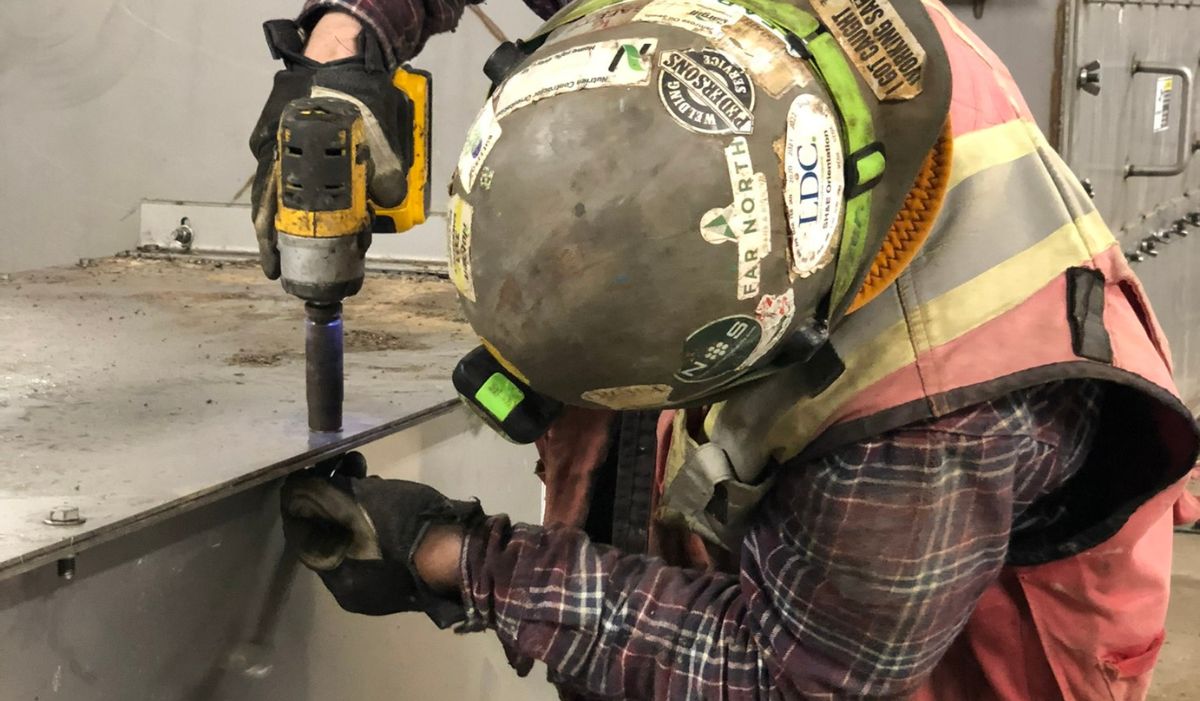
This is where CWB certification becomes directly relevant to hopper fabrication quality. At Credence, our Steel Fabrication shop operates as a CWB-certified facility. Every structural weld is performed to a documented weld procedure specification that defines weld type, joint preparation, filler material, preheat requirements, and inspection criteria. That documentation does not exist to satisfy paperwork requirements. It exists because weld consistency at high-stress joints is what separates a hopper that performs over a twenty-year service life from one that cracks at year three.
Fabricating to Design Drawings Without Field Verification
A hopper fabricated in a shop needs to integrate with real equipment in a real facility. If the fabricator is working from design drawings that have not been verified against actual field measurements — the existing discharge conveyor, the support steel elevation, the clearances around adjacent equipment — dimensional mismatches are almost guaranteed.
This is why the shop drawing review process is not administrative overhead. It is the step where design dimensions get reconciled with field reality before steel is cut. Every hopper Credence fabricates starts with a reviewed and approved shop drawing that reflects verified field measurements — not assumptions about what the installation conditions will be.
Ignoring Prairie Temperature Extremes in Connection Details
Saskatchewan and Alberta winters are not a footnote in a hopper design. They are a primary design condition. Steel at minus forty behaves differently than steel at plus thirty-five — and a hopper that sees both temperatures in the same operating year needs connection details and weld specifications that account for the full thermal range.
Bolted connection details that allow for thermal movement, appropriate base plate sizing, and cold-weather weld procedures are all considerations that matter specifically for Prairie industrial applications. A fabricator without experience in this climate zone will not instinctively account for these factors — and the hopper they produce will show the consequences of that gap over time.
No Post-Fabrication Inspection Before Delivery
A hopper that leaves the fabrication shop without a documented inspection is a hopper that arrives on site with unknown quality. Dimensional verification against the approved shop drawing, weld visual inspection, and coating or surface preparation inspection should all happen before a component is loaded for transport.
At Credence, every fabricated component is inspected against the approved shop drawing before it leaves our facility. When it arrives on your site, our Construction Solutions team knows exactly what they are installing — and so do you.
What to Look for When Evaluating a Steel Hopper Fabricator
If you are planning a new hopper for a grain handling, fertilizer, or mining application across Saskatchewan or Alberta, these are the questions worth asking before you choose a fabricator.
Do they have experience with your specific material type — not just with hoppers in general? Can they provide shop drawings for review and approval before fabrication begins? Are their welders CWB certified and working to documented weld procedure specifications? Do they perform dimensional and weld inspection before delivery? And do they have the installation capability to ensure the hopper integrates correctly with your existing equipment — or are they handing you a component and walking away?
Steel hopper fabrication done right is an investment that pays back over decades of reliable operation. Done poorly, it pays back in downtime, repairs, and replacement costs that dwarf what the fabrication savings seemed to be at the time.
If you are evaluating your options for a new hopper or a replacement on an existing handling system, connect with the Credence team. Our in-house drafting, fabrication, and installation capability means the entire process — from design verification through to commissioned installation — stays under one accountable roof. For industrial facilities across the Canadian Prairies, that continuity is not a convenience. It is what makes the difference between a hopper that works and one that does not.