Industrial Welding Services in Saskatchewan: What CWB Certification Really Means for Your Project
When you are sourcing industrial welding services in Saskatchewan, CWB certification comes up constantly. Contractors mention it in their proposals. Procurement teams ask for it. Project specs require it. But very few people on the client side actually understand what it means in practice — what it covers, what it does not cover, and what the real consequences are when you skip it.
This guide is written for project owners, operations managers, and procurement professionals in Saskatchewan who need to make informed decisions about welding contractors — not for welders looking to get certified. If you want to understand what CWB certification actually means for your project, how to verify it, and what questions to ask before you sign a contract, this is for you.
What the Canadian Welding Bureau Actually Does
The Canadian Welding Bureau — now operating as CWB Certification — is the national body responsible for certifying companies and individual welders against Canada’s structural welding standards. It was established in 1947 under the Canadian Standards Association and has been embedded in Canada’s national building code ever since.
The CWB certifies against a set of CSA standards. The two most relevant for industrial construction in Saskatchewan are:
CSA W47.1 — the standard for fusion welding of steel structures. This covers structural steel welding used in buildings, equipment platforms, hopper systems, conveyors, and most of the fabricated steel you encounter on industrial and agricultural construction sites.
CSA W59 — the structural welding code for steel, which specifies the design, workmanship, and inspection requirements for welded steel connections.
When a contractor tells you they are CWB certified, they mean their company has been audited against one of these standards and found to have the qualified welders, procedures, and quality systems to perform that type of welding work.
What it does not mean is that every person on their crew is individually certified. CWB certification is a company certification. The individual welders within that company must also be tested and qualified — but the company certification and the welder certification are two separate things. When you are verifying a contractor, you need to check both.
CWB Division 1, 2 and 3: What the Difference Means for You
This is the part that almost nobody explains to clients, and it matters significantly depending on the scope and complexity of your welding project.
Division 1 means the contractor employs a registered professional engineer full-time who is responsible for welding-related activities. Division 1 companies can develop their own weld procedures and take on the most complex structural welding work — including high-consequence applications in pressure equipment, heavy mining infrastructure, and large-span structural steel.
Division 2 means the contractor retains a registered professional engineer on a part-time basis. They can still develop their own weld procedures and take on a wide range of industrial welding work, but the engineering oversight is not embedded in the day-to-day operation to the same degree as Division 1.
Division 3 means the contractor has no engineer requirement. They do not develop their own weld procedures — they are certified to follow another company’s approved procedures. Division 3 is appropriate for lower-complexity welding work but should not be your first choice for structural connections, high-pressure systems, or any welding where failure would have serious consequences.
For most industrial welding services in Saskatchewan — steel platforms, structural connections, hopper fabrication, pipe fitting systems — you want at minimum a Division 2 contractor. For anything involving pressure equipment, mine site infrastructure, or large-span structural steel, look for Division 1.
What Happens When You Use a Non-CWB Certified Welding Contractor
This is the question most clients never ask until something goes wrong.
If a welded structure fails and the welds were not performed by a CWB certified contractor in compliance with the applicable CSA standard, the consequences include:
Building permit and inspection failure — In Saskatchewan, building inspectors check for CWB certification compliance on structural steel projects. If the welding does not meet the standard, the structure will not pass inspection and cannot be occupied or operated legally.
Insurance liability — If a non-compliant weld contributes to structural failure, equipment damage, or injury, your insurance coverage may be voided or disputed. Most commercial property and liability policies exclude losses arising from non-compliant construction work.
Personal and corporate liability — As the project owner, you have a duty of care to ensure that contractors performing structural work on your site are qualified. If you knowingly awarded a welding contract to a non-certified contractor and a failure results in injury, that liability exposure extends beyond the contractor to you.
Rework cost — Welding that does not meet CWB standards may need to be cut out and redone by a certified contractor before the structure can be signed off. Depending on where the non-compliant welds are, this can be extremely expensive and time-consuming.
In Saskatchewan’s industrial sector — where facilities like grain handling plants, potash support structures, and agricultural processing buildings operate under significant load and process conditions — the risk of non-compliant welding is not theoretical. It is a genuine operational and safety exposure that gets discovered eventually, usually at the worst possible time.
Industrial Welding Applications in Saskatchewan: What Each Sector Requires
Saskatchewan’s industrial base spans several distinct sectors, each with its own welding requirements and applicable standards.
Grain handling and agricultural processing
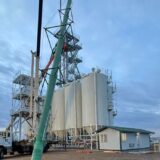
Grain storage terminals, conveyor systems, bucket elevators, hopper bottoms, and material handling equipment all involve structural welding that needs to meet CSA W47.1 requirements. The loads involved — including dynamic loads from grain flow and impact — mean that weld quality directly affects the service life and safety of the equipment. Credence’s welding work in this sector includes custom hopper fabrication, conveyor structure repair, and structural steel repairs to grain handling facilities across Saskatchewan.
Potash and mining
The potash mining sector in Saskatchewan is going through one of its most active periods in decades. Facilities like BHP’s Jansen mine and ongoing production operations at existing potash sites require structural welding that meets stringent quality standards. Mine site welding often involves high-alloy steels, complex joint configurations, and work in demanding environmental conditions. Division 1 or Division 2 CWB certification is typically required by the facility owner for any structural welding on mine sites.
Oil and gas and energy infrastructure
Pipeline tie-ins, processing equipment supports, skid fabrication, and pressure vessel work all fall under specific CWB and ASME standards depending on the application. If your project involves any pressure-containing welds, the applicable standard goes beyond W47.1 into pressure equipment codes, and you need a contractor who understands the difference and is certified accordingly.
Repair and maintenance welding
Ongoing repair and maintenance welding on industrial equipment — conveyor components, structural repairs, equipment mounting systems, access platforms — is often underestimated in terms of its quality requirements. Just because it is maintenance work does not mean it falls outside the scope of CWB standards. If the repair involves a structural connection or a load-bearing component, the same certification requirements apply.
How to Verify CWB Certification Before You Award a Contract
Do not take a contractor’s word for it. CWB certification is publicly verifiable through the CWB Group’s online directory at cwbgroup.org. Before you award any structural welding contract, take these steps:
Step 1 — Search the CWB company directory. Look up the contractor by company name. Confirm their certification is current, confirm the division level, and confirm which standards they are certified to. Certification needs to be renewed regularly — an expired certification is not a valid certification.
Step 2 — Request the welder qualification records. Ask the contractor to provide qualification records for the specific welders who will be performing the work on your project. CWB welder qualifications are process and position-specific — a welder certified for flat position groove welding is not automatically qualified for overhead or vertical welding. Make sure the qualifications match the actual work.
Step 3 — Confirm applicable weld procedures. Ask the contractor which weld procedure specifications they will follow for your project. A Division 1 or 2 company will have their own pre-qualified procedures. Review the procedures and confirm they are appropriate for the base metal, joint configuration, and service conditions of your project.
Step 4 — Ask about inspection. Find out how welds will be inspected during the project. Visual inspection is standard, but high-consequence welds may require non-destructive testing — ultrasonic testing or radiographic testing — to verify internal weld quality. Know what level of inspection your project requires and confirm the contractor can deliver it.
What Good Industrial Welding Services Look Like in Saskatchewan
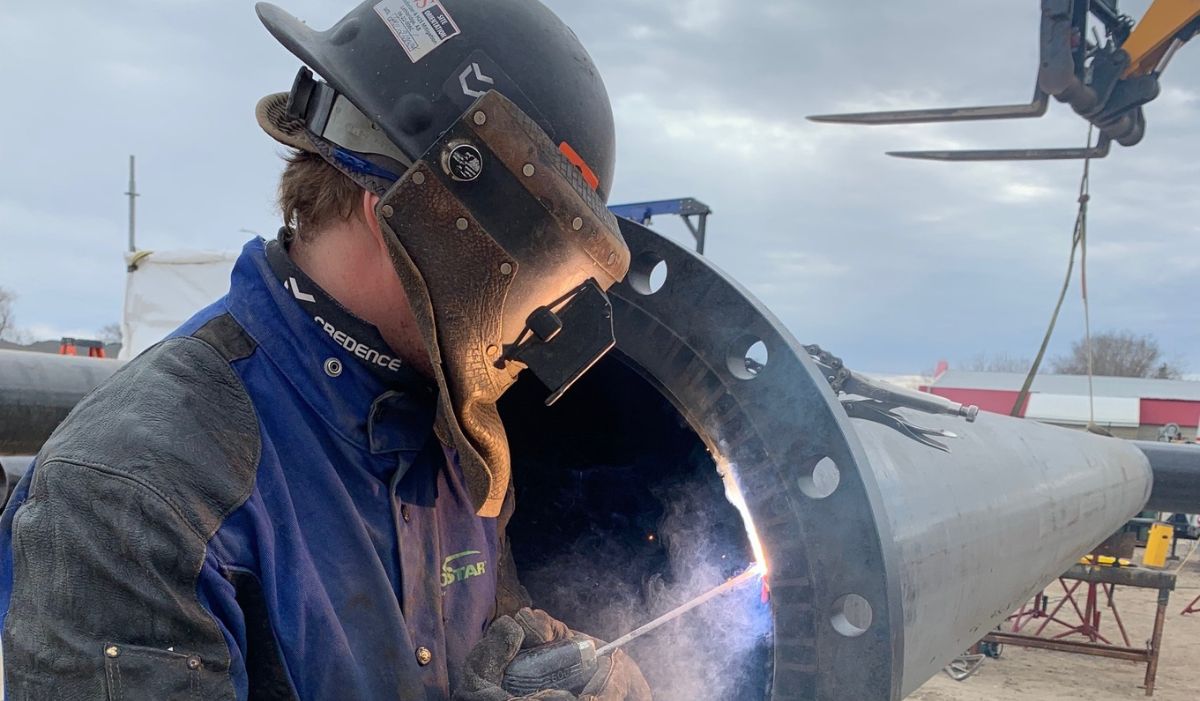
A qualified industrial welding contractor in Saskatchewan does not just show up with a machine and start burning rod. They read the drawings. They understand the base materials and select the appropriate filler metals. They follow pre-qualified procedures. Their welders know the applicable positions and processes and have current qualifications to prove it. Their work is inspected — by themselves and, where required, by a third party.
They also understand Saskatchewan’s specific operating conditions. Agricultural structures that see -40°C winters and full grain loads simultaneously. Mine site platforms that carry heavy dynamic loads in corrosive environments. Industrial equipment that runs around the clock and cannot afford a weld failure at the worst possible time.
At Credence Construction, our steel fabrication and welding services are performed by CWB certified welders working to documented weld procedures. We work across Saskatchewan’s agricultural, mining, and industrial sectors, providing welding services for new construction, equipment repair, structural reinforcement, and custom fabrication. Our welding work is integrated with our broader industrial construction services — which means welds are coordinated with the structural, mechanical, and scaffolding trades rather than being treated as an isolated activity.
If you have an industrial welding project in Saskatchewan and want to talk through your requirements, contact our team. We are based in Yorkton and work across the prairie provinces.
Frequently Asked Questions
- Is CWB certification required by law in Saskatchewan?
CWB certification is required wherever the applicable building code or project specification references CSA W47.1 or W59. In practice, this covers virtually all structural steel welding on permitted construction projects in Saskatchewan. For industrial facilities, mine sites, and agricultural processing buildings, CWB certification is a standard requirement.
2. How often do CWB certified welders need to be retested?
Individual welder qualifications under CSA W47.1 must be renewed every two years. Welders must be employed by a CWB certified company for their qualification to remain valid — a welder who leaves a certified company cannot carry their individual certification to a non-certified employer.
3. What is the difference between a CWB certified welder and a CWB certified company?
A CWB certified company has been audited and approved to perform structural welding work under a specific division and standard. A CWB certified welder is an individual who has passed a practical welding test for specific processes and positions. Both are required for compliant structural welding — the company certification alone does not guarantee every welder on the crew is individually qualified.
4. Can a Division 3 company perform industrial welding on Saskatchewan construction projects?
Division 3 certification covers companies that follow another company’s approved weld procedures without having their own engineer. For lower-complexity applications this may be acceptable, but for structural connections, load-bearing fabrication, and any welding on industrial facilities in Saskatchewan, Division 1 or 2 is strongly recommended and often required by the facility owner or project specification.
5. What should I ask a welding contractor before awarding a contract in Saskatchewan?
Ask for their current CWB company certification and division level. Ask for welder qualification records for the crew assigned to your project. Ask which weld procedures they will follow. Ask about inspection — what is included and whether non-destructive testing is available if required. And verify the company certification independently through the CWB Group’s online directory before you commit.