
Structural Steel Repair vs. Replacement: How to Decide
Somewhere on every industrial facility, there’s a corroded brace, a damaged connection, or a section of steel that’s seen better decades — and somewhere near it, a maintenance manager staring at the same question: fix it or replace it? Structural steel repair vs. replacement isn’t a decision with a formula behind it. It’s a judgment call built on the extent of the damage, what the steel needs to keep carrying, and how much risk the facility is willing to live with in the meantime.
Get the call right, and you’ve bought years of reliable service for a fraction of what a new member would cost. Get it wrong — patch something that needed replacing, or tear out something that could have been saved — and the mistake shows up later as unplanned downtime or wasted budget. This guide walks through how the structural steel repair vs. replacement decision actually gets made on real industrial sites, the methods behind each option, and where the standards and inspections fit in.
What the Structural Steel Repair vs. Replacement Decision Really Comes Down To
The structural steel repair vs. replacement question isn’t answered by looking at a beam and guessing. It’s answered by assessing a handful of specific factors, usually together rather than in isolation.
Extent of section loss. Corrosion doesn’t just sit on the surface — over time it eats into the actual cross-section of the steel, reducing the area available to carry load. A member with light surface corrosion and its full original section intact is a very different situation than one with measurable pitting or thinning across a structural flange. This is exactly why we made the case in our post on industrial coatings for structural steel that protecting steel properly the first time avoids this decision altogether.
Connection integrity. A member can be structurally sound while the connection holding it in place is not, and vice versa. Cracked welds, elongated bolt holes, or corrosion concentrated at a connection point often changes the calculus entirely — sometimes a connection repair solves the problem without touching the member itself.
Remaining load capacity margin. Every structural member is designed with capacity beyond its expected load. Damage that eats into that margin without exceeding it may still leave a structure safe to repair; damage that erodes the margin close to zero pushes hard toward replacement, because there’s no cushion left for error or future deterioration.
What the steel actually needs to do going forward. A member facing a load increase — new equipment, a process change, added platforms — needs to be evaluated against its future demand, not just whether it currently passes. Sometimes a technically repairable member still gets replaced because the facility has outgrown what it was originally designed to carry.
Accessibility and remaining service life. A repair on an easily accessible member in a low-consequence area carries a different risk profile than the same repair buried inside a process area that won’t be accessible again for years. If a structure needs to perform reliably for another two decades, the repair has to be able to promise that — not just get it through the next inspection cycle.
None of these factors work alone. An experienced engineer weighs them together, and this is deliberately not a decision to make from a visual inspection alone — which brings us to how that assessment actually happens.
How Engineers Assess Steel Before Making the Repair vs. Replacement Call
Before any decision gets made, the steel gets evaluated — and increasingly, that evaluation goes well beyond a visual walk-around. Nondestructive testing (NDT) methods let engineers see what’s happening inside the material without cutting into it: ultrasonic testing to measure remaining wall thickness and detect internal flaws, magnetic particle inspection for surface-breaking cracks, and radiographic testing where a permanent record of a critical joint is needed. Our post on choosing a structural steel fabricator goes into more detail on these methods and why the capability to run them matters.
For anything beyond routine maintenance, a professional engineer’s involvement isn’t optional — it’s how the repair-or-replace decision gets certified as sound. In Canada, structural work is governed by CSA S16, the national standard covering the design and construction of steel structures, and any repair that affects load-bearing capacity typically needs engineering review and sign-off before work proceeds. That certification isn’t red tape; it’s the record that confirms the repaired structure can still do its job safely, and it’s often required for insurance and regulatory purposes regardless of how confident the crew doing the work might be.
Structural Steel Repair Techniques That Actually Work
When repair is the right call, several established methods come into play, chosen based on the type and location of the damage.
Splicing replaces a damaged section of a beam or column with new steel, welded or bolted into place to restore full capacity at that point. It’s one of the most common repair techniques for localized damage — a corroded end, an impact-damaged section — where the rest of the member remains sound.
Doubler plates and reinforcement add steel alongside or around an existing member to restore lost capacity without removing the original piece. This approach works well where section loss is distributed rather than localized, and where taking the member fully out of service for splicing isn’t practical.
Weld repair addresses cracked or deteriorated welds directly, often paired with NDT to confirm the repair achieved full penetration and integrity before the connection is returned to service.
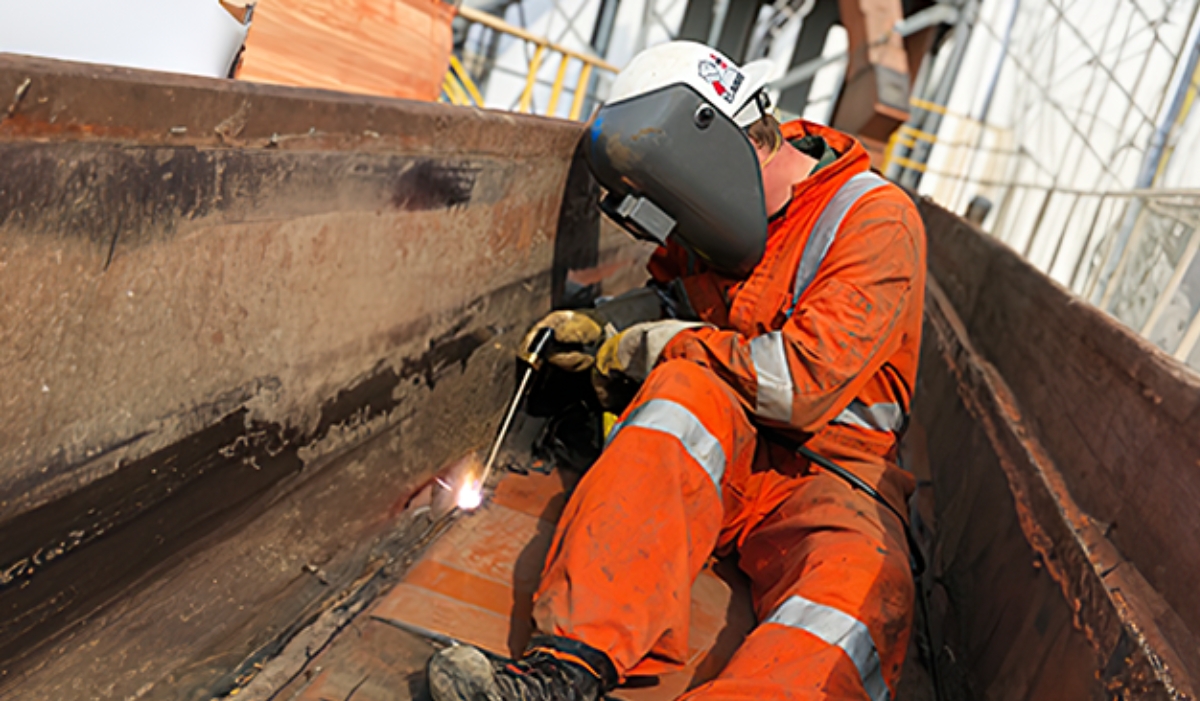
Cold repair vs. hot repair methods is a real distinction worth understanding. Hot repair involves welding, which requires careful control of heat input to avoid distorting the surrounding steel or affecting its material properties — critical on members already carrying load. Cold repair methods, like bolted doubler plates or mechanical clamping systems, avoid heat entirely, which matters when welding near flammable materials, energized equipment, or process areas where hot work isn’t practical or permitted.
Whichever technique applies, temporary shoring is often part of the picture — supporting the load a damaged member normally carries while repair work happens, so the structure stays safe throughout the process rather than only at the end of it.
When Replacement Is the Right Call
Replacement earns its place when repair simply can’t restore what the structure needs. Severe, widespread section loss across a member rarely responds well to patching. Structural members that have been altered by a previous poor repair, damage from a significant impact, or fire exposure often fall into this category too — sometimes it isn’t obvious until an engineer opens up the assessment that what looks fixable at the surface has compromised the steel more deeply underneath.
There’s also a legitimate business case for replacement even when a member is technically repairable: if a facility is expecting increased loads, if repair access will only get harder over time, or if the maintenance cost of monitoring a marginal repair over years exceeds the cost of a clean replacement now. This is where the structural steel cost factors we’ve covered elsewhere come into the conversation directly — fabrication lead time, erection logistics, and downtime during the swap all belong in the comparison, not just the price of the steel itself.
That said, replacement isn’t automatically the safer or cheaper choice. The hidden costs of replacement are real: production downtime while the new member is fabricated and installed, temporary shoring or bracing needed during the swap, and sometimes disruption that ripples well beyond the immediate work area. A well-executed repair, done to the same engineering standard, can deliver the same safety outcome for a fraction of the disruption — which is exactly why this decision deserves a proper assessment rather than a default answer in either direction.
Choosing Who Makes — and Executes — This Decision
The structural steel repair vs. replacement decision is only as good as the people making it. A few questions are worth asking before committing to either path:
- Does the contractor have in-house or partnered NDT capability, or are they relying on visual inspection alone?
- Will a professional engineer review and certify the decision, not just the crew doing the work?
- Can they show experience with both repair techniques and full replacement — a contractor who only does one tends to recommend it regardless of what the steel actually needs?
- How do they plan to keep the structure safe throughout the work, including temporary shoring where needed?
A contractor with in-house drafting, fabrication, and field crews — rather than one juggling subcontractors for each piece — tends to move through this process with fewer handoffs and less risk of something getting lost between the assessment and the work itself.
Frequently Asked Questions About Structural Steel Repair vs. Replacement
How do you know if structural steel needs to be repaired or replaced?
The decision depends on the extent of section loss, the condition of connections, remaining load capacity margin, and what the steel needs to carry going forward. A qualified engineer typically assesses these factors using visual inspection combined with NDT methods before recommending repair or replacement.
When is engineer certification required for structural steel repair?
Any repair that affects a member’s load-bearing capacity generally requires review and sign-off from a professional engineer, in accordance with standards like CSA S16 in Canada. Minor, non-structural maintenance may not require the same level of certification, but anything touching structural capacity should be engineer-reviewed.
What’s the life expectancy of repaired steel compared to a full replacement?
A properly engineered and executed repair can restore a structural member to its full intended service life, provided the underlying cause of the damage — often corrosion — is also addressed so the same problem doesn’t recur. Replacement resets the clock entirely on that specific member, but a well-executed repair is not inherently a shorter-term fix.
Is it always cheaper to repair structural steel than to replace it?
Not always. Repair usually costs less upfront, but replacement can be the better value when a member has widespread damage, when future loads will exceed what a repair could safely support, or when ongoing monitoring and maintenance of a marginal repair adds up to more than a clean replacement over time.
Making the Call With Confidence
Structural steel repair vs. replacement isn’t a decision to make from a distance or a photo. It takes a real assessment — section loss, connection condition, remaining capacity, and what the structure needs to do for the next decade, not just the next inspection. Get that assessment right, and the rest of the decision usually becomes clear.
Credence Construction assesses, repairs, and replaces structural steel for mining, agricultural, and industrial clients across Saskatchewan, Alberta, Manitoba, and Western Ontario, backed by CWB-certified fabrication and in-house engineering coordination from drafting through field erection. If you’ve got a structural steel question that needs a real answer rather than a guess, call us at 306-786-7000.
1 Comment
Comments are closed.