Industrial Scaffolding: The Complete Guide for Mining and Agricultural Facility Owners in Saskatchewan and Alberta
Industrial scaffolding is one of those services that every facility manager knows they need — and almost nobody thinks about carefully enough until a project is already underway and the access is wrong.
That statement applies across the Canadian construction industry. But in Saskatchewan and Alberta, where industrial scaffolding gets used on potash mines, grain terminals, fertilizer processing plants, and agricultural facility shutdowns — often in extreme weather, on remote sites, with multiple trades working simultaneously — the consequences of getting it wrong are more immediate and more expensive than anywhere else.
This guide is written specifically for operations managers, project leads, and procurement teams at mining and agricultural facilities across the Canadian Prairies. It covers what industrial scaffolding actually involves at this scale, how Saskatchewan and Alberta regulatory requirements affect your projects, how to plan scaffold access for complex multi-trade industrial work, and what separates a scaffolding contractor who can genuinely serve your facility from one who will create problems on your site.
What Is Industrial Scaffolding — And How It Differs From Commercial Scaffolding
Industrial scaffolding is a temporary access system designed for use in operating industrial environments — mining facilities, processing plants, grain handling systems, fertilizer facilities, and heavy manufacturing sites. It is not the same as commercial or residential scaffolding, even though the basic components overlap.
The differences are real and they matter.
Commercial scaffolding typically supports painters, cladding installers, and maintenance crews on building exteriors. The loads are predictable. The access points are straightforward. The site is usually static — no operating equipment, no live process systems, no other trades working simultaneously in the same space.
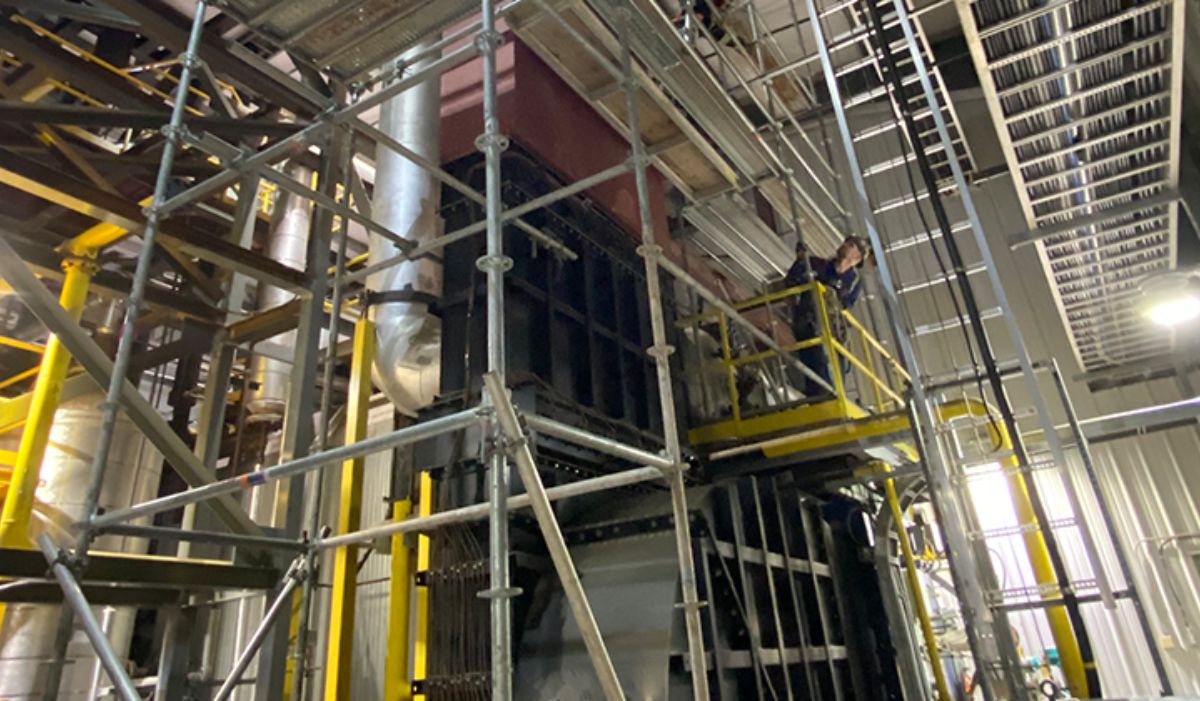
Industrial scaffolding on a potash processing platform or a grain terminal elevator leg operates in a completely different environment. The structure is carrying millwrights, ironworkers, and welders who may be working with heavy components. The site has live electrical systems, operating process equipment, and active production running adjacent to the scaffold. The access has to be engineered to fit the specific geometry of the facility — not adapted from a standard configuration. And the documentation requirements — inspection records, load calculations, engineer certifications for complex configurations — are significantly more rigorous than standard commercial scaffold work.
Understanding this distinction is the first thing facility owners need to get right before evaluating any industrial scaffolding contractor.
Industrial Scaffolding Systems Used on Prairie Industrial Sites
Not every scaffold system is appropriate for every industrial application. The choice of system affects erection speed, load capacity, adaptability to complex geometry, and cost. Here is what each major system is suited for in the Prairie industrial context.
Ringlock and Cuplock Systems
These modular systems — built around vertical standards with horizontal ledgers that lock into rings or cups at fixed intervals — are the workhorses of industrial scaffolding across Saskatchewan’s potash and fertilizer sector. Their speed of erection matters enormously on planned turnarounds where every hour of the shutdown window has a dollar value attached to it. They are strong, well-suited to repetitive bay configurations, and adaptable enough to handle most standard industrial access requirements. For a maintenance shutdown at a potash mine or a planned turnaround at an agricultural processing facility, these systems typically provide the right balance of speed and load capacity.
Tube and Clamp Systems
When a facility has irregular geometry — tight clearances around operating equipment, non-standard heights, or access requirements that do not fit a modular grid — tube and clamp scaffold provides the flexibility to work around constraints that modular systems cannot accommodate. It takes longer to erect and requires more skilled scaffolders to build correctly. However, on a complex facility upgrade or a maintenance task in a confined industrial space, it is often the only system that actually fits. We covered the specific limitations of standard tube and clamp configurations and when to use them in our dedicated guide to why tube and clamp scaffolding is not always the best fit for industrial projects.
Engineered Custom Scaffold
Some industrial access requirements in Saskatchewan fall outside what any standard scaffold catalogue covers. A suspended scaffold over active process equipment, a cantilevered platform providing access to a grain leg head in a confined headhouse, a crash deck spanning between structural columns at significant height — these configurations require engineering design before erection. Under Saskatchewan OHS regulations, heavy-duty scaffolds used at heights beyond standard thresholds, scaffolds that deviate from manufacturer specifications, and suspended scaffold configurations must be designed and certified by a professional engineer. The signed certification must be kept on site. This requirement catches many industrial operators off guard during maintenance turnarounds when suspended scaffold is erected quickly to access elevated equipment.
Saskatchewan and Alberta Regulatory Requirements for Industrial Scaffolding
Regulatory compliance for industrial scaffolding in Saskatchewan and Alberta is more specific and more demanding than many facility managers realise until they are in front of an OHS inspector.
In Saskatchewan, industrial scaffolding is governed under the Saskatchewan Employment Act and the Occupational Health and Safety Regulations, 2020, with Part 12 specifically covering scaffolds, aerial devices, elevating work platforms, and temporary supporting structures. The CSA Z797:23 standard — Code of Practice for Access Scaffold — provides the technical framework that Saskatchewan OHS regulations reference for scaffold design and erection requirements.
Several requirements consistently catch Saskatchewan industrial operators off guard. Scaffold erection and dismantling must be performed by a qualified worker — meaning someone with specific training and experience relative to the type of scaffold being used, not a general labourer reassigned to the task. A fall protection system is mandatory for any worker at 3 metres or higher, though many industrial sites apply stricter internal requirements. After any modification to an erected scaffold — even moving a guardrail section or adding a plank — the scaffold must be re-certified for use. And after extreme weather events common in Saskatchewan, including high wind gusts and heavy ice accumulation, a formal re-inspection is required before the scaffold is used again.
In Alberta, industrial scaffolding falls under the Alberta Occupational Health and Safety Code, Part 23, which parallels Saskatchewan’s requirements in most areas. The ACSA (Alberta Construction Safety Association) COR certification requirements for contractors working on mine sites and industrial facilities add another layer of compliance that any contractor serving Alberta’s industrial sector must demonstrate.
Our detailed breakdown of Saskatchewan OHS regulations for industrial scaffolding covers the specific regulatory requirements that apply to your facility. Understanding these requirements before a project starts — not after an inspector arrives — is what keeps your project compliant and your team safe.
Planning Industrial Scaffolding for Complex Prairie Facility Work
The single biggest mistake industrial facility owners make with scaffolding is treating it as something to be figured out after the project scope is defined. On a complex industrial shutdown or facility upgrade, scaffolding is not a logistical detail. It is a project planning decision that affects every other trade on site.
Here is why this matters practically.
A scaffolder who arrives on site with a standard erection plan — not knowing that the mechanical crew needs the platform at a specific height to access a bearing that needs to come out in a particular direction, or that the weld inspector needs clearance on three sides of a connection, or that the structure has to be stripped in a specific sequence to allow the ironworker to complete their installation — will build a scaffold that technically provides access but practically creates delays for every other trade.
On a planned turnaround at a Saskatchewan grain terminal or a potash facility maintenance shutdown where every hour of downtime has a real cost, those delays are not abstract. They show up as overtime, extended shutdown windows, and the kind of budget conversations nobody wants to have.
The solution is integrating scaffolding planning into the pre-shutdown or pre-construction planning process — not treating it as a service to be procured separately once the other scopes are defined. Our comprehensive guide to smart scaffolding planning for industrial plant shutdowns covers exactly how this pre-planning process works and what it prevents.
Prairie-specific considerations add additional planning complexity that contractors without Western Canadian industrial experience often miss. Saskatchewan’s temperature range from minus forty in January to plus thirty-five in July creates challenges that affect scaffold erection procedures, base plate installation, and personnel working on platforms in extreme cold. Frozen ground affects base plate bearing capacity and must be assessed before heavy scaffold loads are placed. High Prairie winds on exposed agricultural and mining sites require scaffold tie-back spacing and anchor design that exceeds what most standard scaffold designs assume.
How Multi-Trade Integration Changes Everything About Industrial Scaffolding
Most industrial facilities in Saskatchewan and Alberta manage scaffolding as a separate contract — a scaffolding company erects what they are asked to erect, and the other trades work around whatever access is provided. This approach creates the coordination gaps that show up most visibly during turnarounds and shutdowns.
When the scaffolding company is working from a separate scope that was not coordinated with the millwright scope, the ironworker scope, and the welding scope, nobody is responsible for managing the interface between access and work. The scaffold goes up where the plan shows it should go. The millwright arrives and discovers the access geometry does not let them swing the component they need to remove. The scaffold has to be modified. Time is lost. The sequence is disrupted.
At Credence Construction, our scaffolders are not a separate subcontracted crew arriving from a different company with a different project manager. They are part of the same multi-trade team delivering the mechanical, structural, and welding scope under a single management structure. When the sequence changes — because an inspection reveals additional work, because a component is more corroded than the drawing showed, because a crane pick needs to happen in a window that was not in the original plan — the scaffold access adjusts as part of the same decision, not through a separate negotiation with a separate contractor.
This integration is directly relevant to how industrial scaffolding services function at Credence — our scaffolders join other teams on site and are available for scaffolding tasks across multiple scopes, not locked into a single scaffold contract while other work waits for access.
Industrial Scaffolding Safety on Prairie Industrial Sites
Safety on industrial scaffolding in Saskatchewan and Alberta is not just a regulatory compliance topic. It is an operational reality that shapes how every scaffold gets designed, erected, used, and inspected on a live industrial site.
Falls from height remain one of the leading causes of serious workplace injury and fatality in the Canadian construction industry. But on an industrial site — where workers on scaffold platforms are also working with heavy mechanical components, in proximity to live electrical systems, adjacent to operating process equipment, and in weather conditions that can change rapidly — the hazard profile is more complex than a standard fall protection analysis captures.
The industrial scaffolding safety practices that matter most on Prairie industrial sites go beyond the regulatory minimums. Pre-erection hazard assessment that specifically identifies overhead electrical hazards — common on agricultural processing sites and mining facilities — is one area where shortcuts create serious risk. Proximity to energized lines is non-negotiable, and failing to identify and control these hazards before scaffold erection begins is one of the most serious OHS exposures on any Saskatchewan industrial site.
Load assessment for industrial scaffolding also differs from commercial applications. On an industrial facility, load does not just mean the weight of workers. It includes the weight of specialized tools, heavy mechanical components being handled during maintenance, and environmental loads — snow accumulation on platforms during Saskatchewan winters is a load that has to be accounted for in platform design, not managed by asking workers to sweep it off.
Every scaffold Credence erects on an industrial site is followed by a documented inspection report — a formal record that the structure meets the required standard before any trade accesses it. That documentation protects the facility, protects the crew, and provides the compliance record that regulatory inspectors and internal safety auditors need to see.
What to Look for When Hiring an Industrial Scaffolding Contactor in Saskatchewan or Alberta
The evaluation of a scaffolding contractor for industrial work in Saskatchewan and Alberta should start with specific questions, not generic capability statements.
COR certification status is the baseline. A contractor without current COR certification through the SCSA in Saskatchewan or the ACSA in Alberta has not been independently verified to meet the safety management standards that operating mine sites and major agricultural facilities require as a minimum for site access.
Beyond certification, the questions worth pressing on are specific. Can the contractor demonstrate experience with the facility type that matches yours — potash mining infrastructure, grain handling systems, fertilizer processing facilities — rather than general industrial experience that may not reflect the specific access and safety challenges your site creates? Can they provide engineer-certified designs for complex scaffold configurations that fall outside manufacturer specifications? Do they produce documented inspection reports for every scaffold they erect? And can they integrate their scaffolding scope with the other trades working on your project, or are they operating as a standalone contractor who will need to be separately coordinated?
Our guide to choosing a scaffolding company in Saskatchewan walks through the full evaluation process. And our practical breakdown of what industrial clients need to verify before awarding access contracts covers the specific questions that reveal whether a contractor is genuinely equipped for industrial site work.
Frequently Asked Questions About Industrial Scaffolding in Saskatchewan and Alberta
Q1: What is the difference between industrial scaffolding and commercial scaffolding?
Industrial scaffolding is designed for use in operating industrial environments — mining facilities, processing plants, and agricultural handling systems — where loads are heavier, access requirements are more complex, regulatory requirements are more stringent, and multiple trades are working simultaneously in the same space. Commercial scaffolding typically supports straightforward building exterior access with more predictable load conditions and simpler regulatory requirements. The distinction matters because contractors experienced in commercial scaffolding are not automatically equipped for industrial applications.
Q2: When does industrial scaffolding in Saskatchewan require engineering design?
Under Saskatchewan OHS Regulations, heavy-duty scaffold configurations, scaffolds used at heights beyond standard thresholds, suspended scaffolds, and any scaffold that deviates from manufacturer specifications require design and certification by a professional engineer. The certification must be kept on site. Most complex industrial access scenarios — cantilevered platforms, suspended scaffold over operating equipment, scaffold in confined spaces with non-standard geometry — fall into this category. Engaging a contractor with in-house design capability or established engineering relationships is the most reliable way to ensure compliance on complex configurations.
Q3: How far in advance should scaffolding be planned for an industrial shutdown in Saskatchewan?
For a complex multi-trade industrial shutdown, scaffolding planning should begin at the same time as the overall shutdown scope is being defined — ideally three to six months before the shutdown window. This allows scaffold configurations to be designed around the sequence of all trades working on site, long-lead material requirements to be identified, engineer certifications to be completed where required, and the scaffold to be available the moment the shutdown window opens rather than being figured out after other trades are already waiting for access.
Q4: What documentation should a scaffolding contractor provide after erecting a scaffold?
At minimum, a qualified scaffolding contractor should provide a documented inspection report confirming the scaffold meets the required standard before any trade accesses it, a scaffold inventory listing all components in the erected structure, and engineer certification documentation for any configuration that requires it under Saskatchewan or Alberta OHS regulations. This documentation protects the facility in the event of a regulatory inspection or a safety incident, and provides the records needed for ongoing inspection requirements throughout the scaffold’s use.
Q5: Can Credence Construction provide industrial scaffolding as part of a broader multi-trade scope?
Yes. Credence’s scaffolding team works as part of our multi-trade crew on every industrial project — alongside millwrights, ironworkers, welders, and carpenters under a single project management structure. This means scaffold access is planned and adjusted as part of the overall project sequence rather than managed as a separate contract. We provide industrial scaffolding services across Saskatchewan and Alberta for planned shutdowns, facility upgrades, new construction, and emergency access requirements at mining, potash, fertilizer, and agricultural processing facilities.
Credence Construction’s Industrial Scaffolding Services Across Saskatchewan and Alberta
Credence Construction provides industrial scaffolding services for mining operations, potash facilities, grain terminals, fertilizer plants, and agricultural processing facilities across Yorkton, Regina, Saskatoon, Prince Albert, Estevan, Lloydminster, and throughout Saskatchewan, Alberta, Manitoba, and Western Ontario.
Our scaffolding scope covers access platforms, crash decks, stair towers, hoarding systems, and custom engineered scaffold structures for complex industrial applications. Every scaffold we erect is inspected and documented with a full inventory and inspection report provided before any trade begins working on the structure.
Our multi-trade capability means scaffolding is integrated with the full project scope — not managed as a separate contract that has to be coordinated around everything else. When a plant turnaround or facility upgrade requires scaffold stripped and repositioned to open access for mechanical or structural work, that decision happens within our team without the delays that come from coordinating between separate contractors.
If you are planning an industrial shutdown, a facility upgrade, or a new construction project in Saskatchewan or Alberta that requires industrial scaffolding, connect with the Credence team during your planning phase. The access conversations that happen before a project starts are always more productive than the ones that happen after trades are already on site waiting.